
Have you ever asked yourself why you like a certain brand? Why you want to buy Apple instead of Samsung? Why your mouse makes that sound when you click on your computer? Think also about the sound made by your juice bottle when you open it. Do you think that all of these are coincidental?
Nowadays, science gives you the answer, so, I would like to invite you into the world of Neuromarketing and Consumer Neuroscience. Welcome and enjoy it!
You’re probably asking yourself – what does Neuromarketing mean and how can it help my brand?
We are talking about a hybrid concept that links neuroscience with psychology and marketing, drillinginto your customer’s thinking using the modern medical technology in order to see their reaction to brands, designs, ads etc.
Intriguing, right? Let’s talk more about it.
According to Ramsøy5 Neuromarketing is the commercial use of neuroscience tools to improve consumer insights and marketing effects, while consumer neuroscience is an academic exercise, where the aim is to use neuroscience to better understand consumer psychology and behavior.
Another opinion2 says that “neuromarketing is all about understanding how our brains works, regardless of the science used, and employing that understanding to improve both marketing and the products”.
In other words, we are talking about “reading consumer’s mind” using scientific proof, of course.
Ok, ok, you will say, but is not this harmful or evil or manipulative?
The answer is no and this is because our intention is the most important thing behind the strategy. Any marketing strategy can be harmful if we intent to, but as Dooley 2 says: “advertising can be fun and informative”. In the same time, neuromarketing is more about understanding brain waves, not controlling them7 and it can be used by marketers to understand their customers and serve them better2.
Now that we take this out completely, let’s speak more about why neuromarketing is important?
First of all, it reveals hidden information that is not visible in any other approaches. More and more brands want to decode why people buy what they do. In traditional marketing research, people are asked what they want, but most of them don’t know. Neuromarketing is focused more on the uncounscious decisions that drive our behaviour looking at various physiological changes that happen in the consumers’ bodies when they are asked a question. This way we get a smarter and evidence based strategy that boosts effectiveness.
In an inteview for Forbes Magazine, Harvard Business School marketing professor Uma R. Karmarkar7 says that neuroscience can also help us understand those hidden elements of the decision process, providing important, but complex data to companies that target a global audience.
Secondly, neuromarketing provides a more efficient cost–benefit trade-off than other marketing research approaches1, the traditional marketing research being the reason why the companies waste a lot of money on failed products 11.
Thirdly, neuromarketing provides early information about product design 1, combining advanced statistical models from computer science with neuroscience data, making it possible to predict behavior in a more accurate way than relying on traditional measures such as self-reports. By combining different tools from the neuroscientific field we can establish brain-behavior relationships that are meaningful for understanding the underlying psychology behind consumer choices4.
Let’s see how we can tap into their brain. What really happens here?
The brain is a one and half kilograms heavy organ, but with a complex world inside.
According to Renvoise6, the brain can be categorized into three distinct parts that communicate between them, but at the same time each has its own specialized function:
- the new brain (or neocortex) that is the rational self. It thinks and processes rational data.
- the middle brain is the emotional self. It deals with emotions and gut feelings.
- the old brain that is instinctual, takes into account the input from the other two brains, but it is the actual trigger of decision.
Patrick Renvoise at TEDxBend: Is There a Buy Button Inside the Brain
Another model is presented by Plassmann and his colleagues (4) and divides the stages that are required for brand preference formation over time into four basic components:
- representation and attention;
- predicted value;
- experienced value;
- remembered value and learning.
The scheme below describes accurately the decision behind choosing between brands. We first identify our options (Pepsi or Cola), then we select the information that gains preferential status above other available information. After this, we evaluate how much enjoyment we will derive from consuming one of the choices and we assign valence and intensity to the consumption experience. Finally, we make decisions based on how different brand associations are encoded, consolidated, and retrieved in our memory. And to think all this process happens in less than 3 seconds.
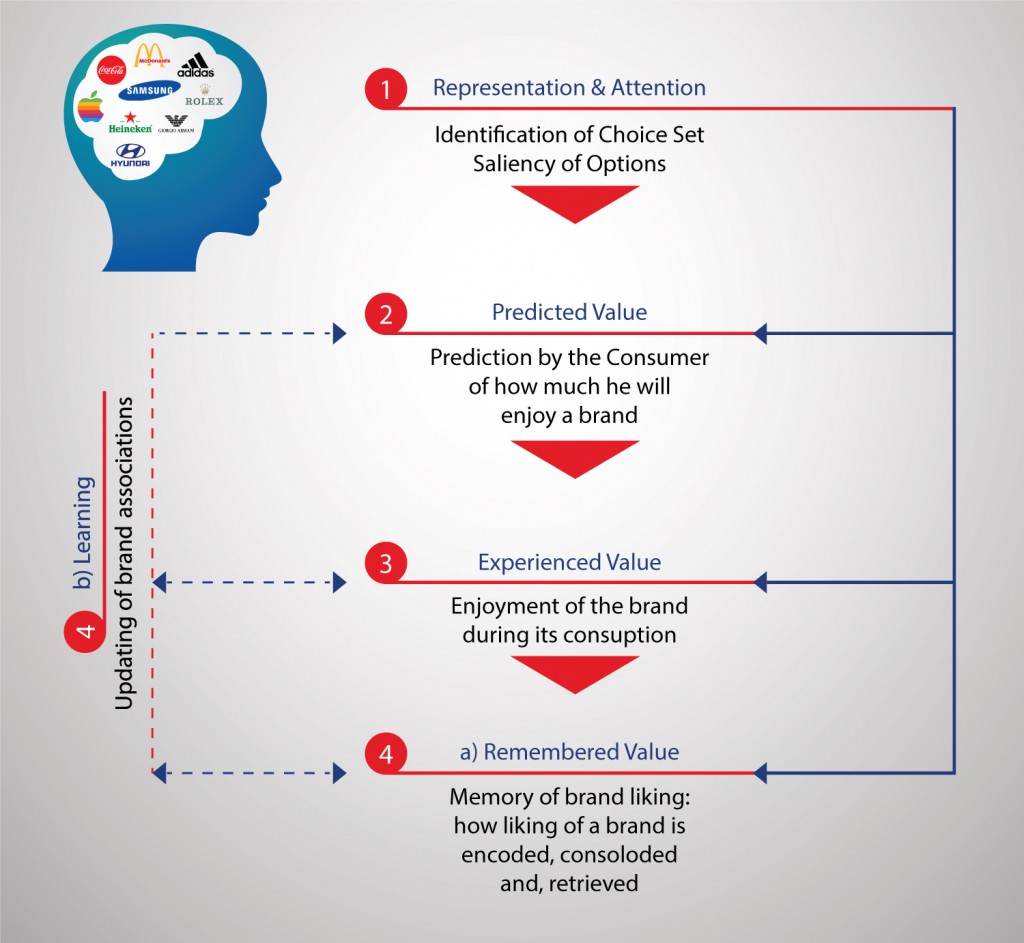
Fig no 1. Brand Decision (Adapted after Plassmann et all, 2012)
What about the neuroscience tools used in branding?
According to Morin (3), the three well established non-invasive methods for measuring and mapping brain activity are:
- Electroencephalography (EEG) is a rather old technology that involves electrodes placed on the scalp of a test subject, typically by using a helmet or a band. Its limitation is that it does not have good spatial resolution which means it cannot precisely locate where the neurons are firing in the brain, especially in deeper, older structures.
- Magnetoencephalography (MEG) is the cousin of EEG having an excellent temporal resolution, but more importantly, a better spatial resolution than EEG.
The best way to use MEG is to measure activity in areas known or expected to produce activity given specific tasks rather than to conduct exploratory experiments.
- Functional magnetic resonance imaging (fMRI) is based on using an MRI scanner to image the change of blood flow in the brain, the key element for a marketing researcher to understand being the contrast of the BOLD (Blood Oxygen Level Dependant) signal measured by it. When faced with a particular stimulus such as an ad, areas of a subject’s brain receive more oxygenated blood flow than they do at rest time. This change creates distortions in the magnetic field emitted by hydrogen protons in the water molecules of our blood.
Compared with the other two technologies, the fMRI has the special resolution 10 times better than them, having the advantage that it is able to image deep brain structures, especially those involved in emotional responses.
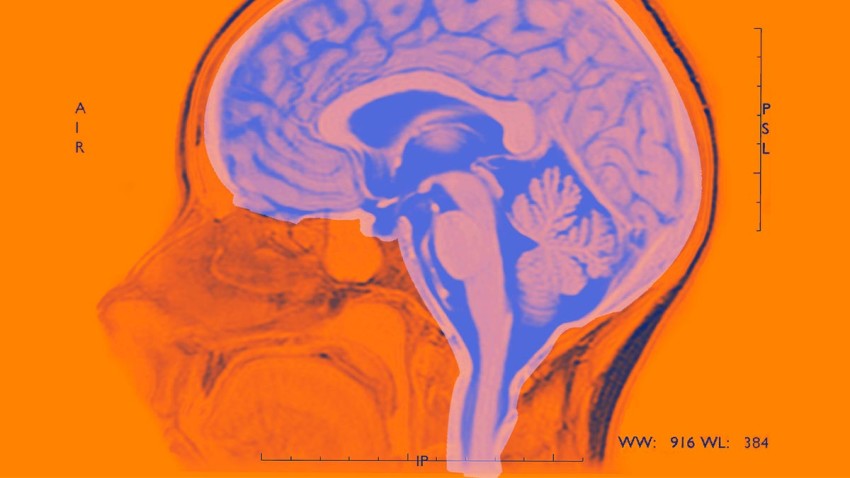
Fig no 2. Brain Scan. Source: Harvard Business Review
- Eye-tracking provides realistic evidence of what people are likely to look at, which makes it a powerful aid in evaluating advertising creative. Eye movements indicate the focus of visual attention with more detail and accuracy than self-reported answers.
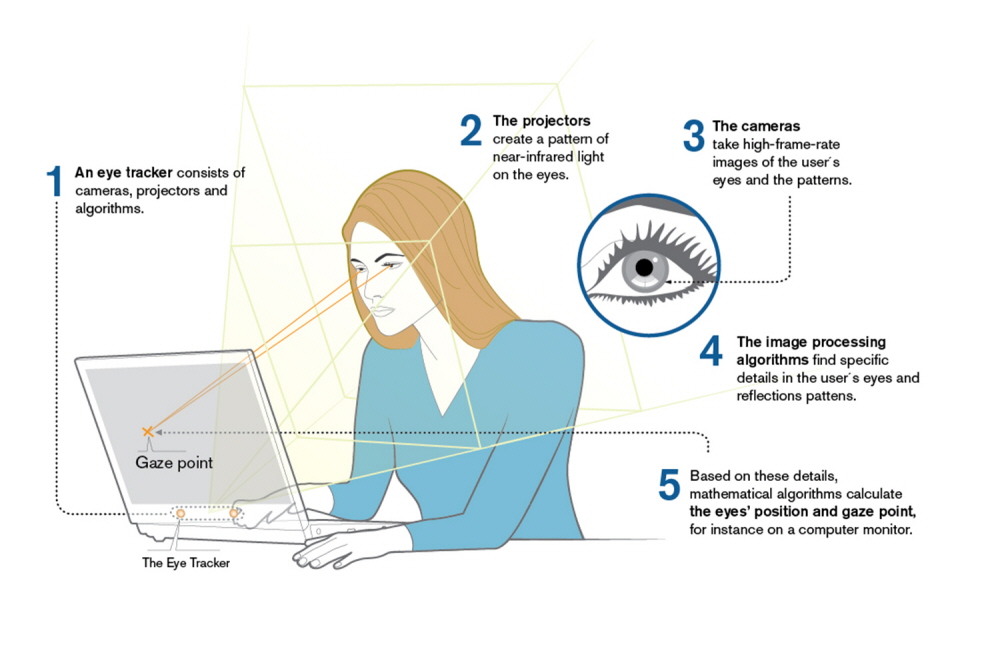
Fig no 3. How the eye tracker works. Source Tobii.com
While neuromarketing is still relatively new, the subject has received more attention lately and the use of these techniques is certainly on the rise, with companies such as Microsoft, Google and Frito-Lay engaging in such activities (8).
Neuromarketing can be not just a helpful method for your business growth, but it can be a powerfull tool in changing people’s self-destructive behaviors. We need it in our lives because it is the breathing air in the branding process. And how can one breathe with no air?
References:
- Ariely, D., Berns, G. S. 2010. Neuromarketing: the hope and hype of neuroimaging in business, Nature Reviews Neuroscience, 11, 284-292.
- Dooley, R. 2012. Braininfluence. 100 ways to persuade and convince consumers with neuromarketing, John Wiley & Sons, Inc.
- Morin, C. 2011. Neuromarketing: The New Science of Consumer Behavior, Society, 48, 131–135.
- Plassmann, H., Ramsøy, T. Z., Milosavljevic, M. 2012. Branding the brain: A critical review and outlook. Journal of Consumer Psychology, 22, 18–36.
- Ramsøy, T. Z. 2014. Selected Readings in Consumer Neuroscience and Neuromarketing, 2nd Edition.
- Renvoise, P., Morin, C. 2007. Neuromarketing. Understanding the “Buy Buttons” in your Customer’s Brain, Thomas Nelson, Brilliance Audio.